

The paradigm shift AI coding brings
A small venture ships something new; a large company rebuilds it with capital and buys the market with advertising. That was the pattern for a long time. Now that AI has driven the cost of implementation down, the premise is breaking — and in a price war still fought in person-months, the smaller fixed cost wins.
For a long time, the IT industry had a reliable way of settling things: the bigger balance sheet wins.
Being second was the stronger position
A small venture ships something new. A little later, a large company uses its capital to build the same thing, pours money into advertising, and takes the market. That was the pattern, over and over.
Whoever went first was not beaten on ideas or on engineering. They were beaten on volume — the headcount you can put on development, the budget you can put on marketing. Going from 0 to 1 mattered less than the capital to go from 1 to 100. "Getting noticed by a big player is the end of you" was not a joke in this industry.
Implementation got cheap
Recent progress in AI has cut the effort a software project takes, dramatically. Settle the specification and the implementation follows. Tests, ports, reading code somebody else wrote — all of it now moves an order of magnitude faster.
What matters is what got cut: the sheer volume of implementation work. The gap that used to be closable only with headcount can now be closed.
The positions swap
The same tools work in the other direction. What a large company built with heavy funding over a long schedule, a handful of engineers can now rebuild to an equivalent standard in a short time. Following fast is no longer a privilege of capital.
The person-month runs backwards
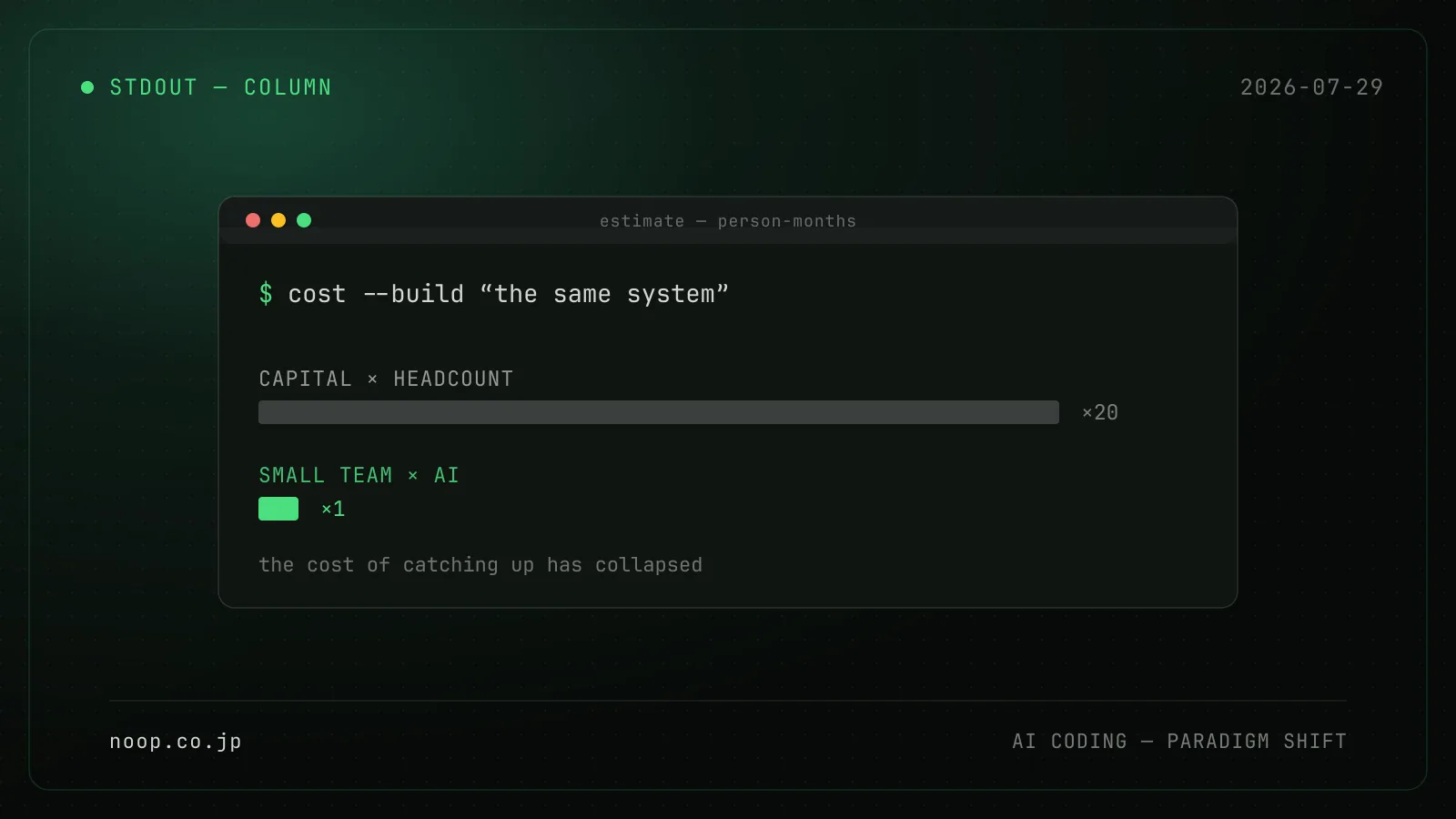
And the commercial convention of this industry is still the person-month. Price is headcount × duration. Keep that unit while the cost of implementation falls, and the destination is a price war.
Once it turns into a race to the bottom, the outcome is obvious: the side with the smaller fixed cost wins. An organisation of a hundred has to keep booking revenue for a hundred, or it stops. An organisation of a few does not.
Headcount moves from asset to risk
For a company that has stayed deliberately small, this is a clear tailwind. And it says the opposite thing just as clearly — carrying a large staff is itself a risk.
Headcount used to be proof of the size of work you could take on: an asset. Now it is a fixed weight standing against a unit price that keeps falling.
What does not change
Even when building gets fast, some work stays. Deciding what to build. Going to where the work actually happens and questioning the premise behind the requirements. Taking responsibility for something that has to keep running. The faster implementation becomes for everyone, the more the difference shows up there.
Being small is no longer an excuse to explain away. It is the premise.
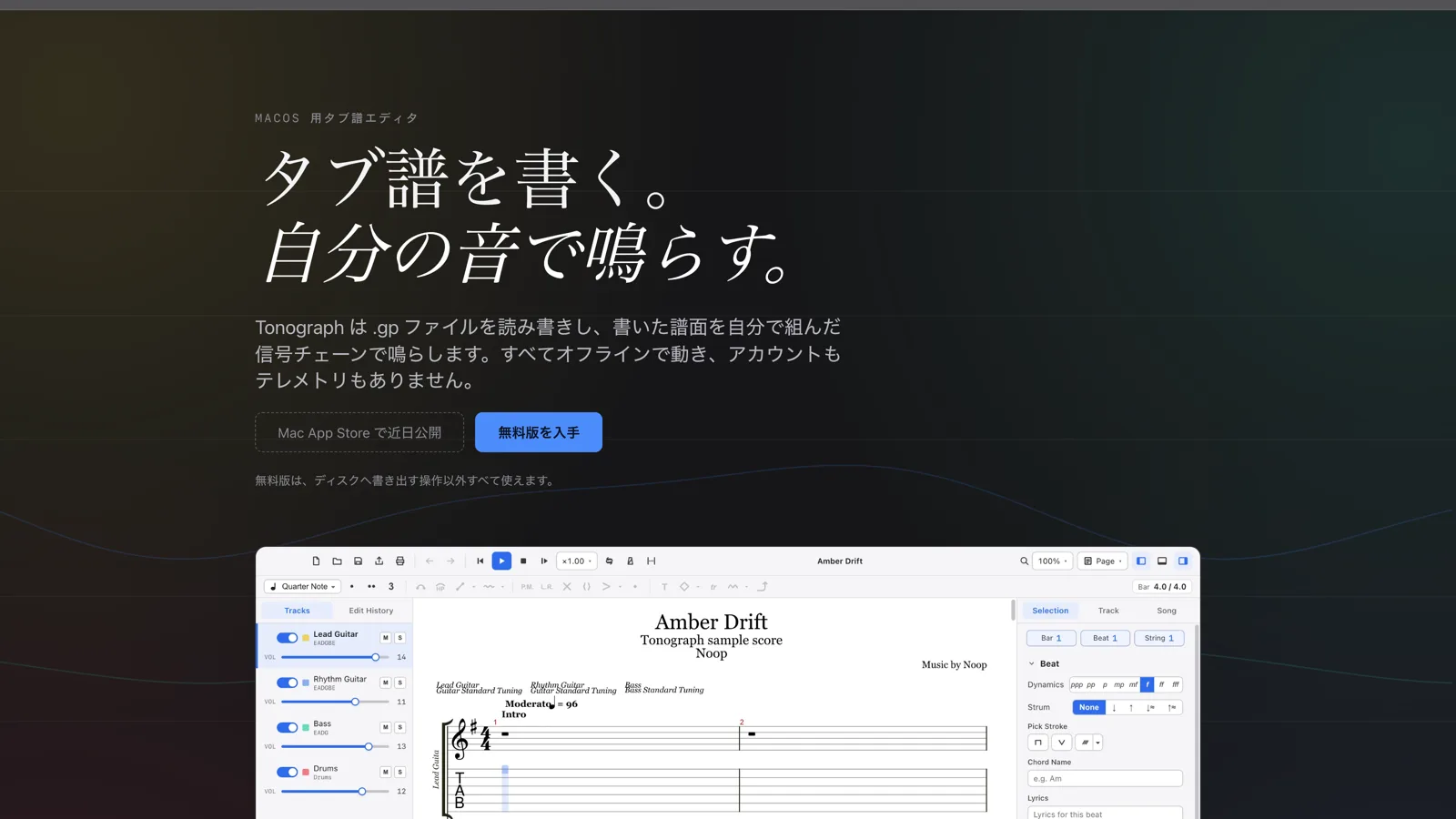
Noop is a one-person company. Even so, from systems running inside a venue to our own product Tonograph, we take a project from design through to operation. One person, outpacing a whole team — that premise only gets stronger from here.
Falling implementation costs erode the advantage of capital. In a price war still priced in person-months, the smaller fixed cost wins.
Noop is a company designed around staying small. We will keep widening the range of work we can take on without adding headcount.